Snacks for mass gaining
When mass gaining stalls, the reason is often not the training but the fact that a person simply does not eat enough. The editorial team broke down how snacks help reach a calorie surplus, which foods work best and how not to gain excess fat in the process.
Why snacks matter for mass gaining
To gain muscle mass three things are needed: a strength training stimulus, sufficient protein and, for most people, a moderate calorie surplus. A review by Slater and colleagues (2019) concluded that an energy surplus, while not absolutely mandatory, substantially facilitates hypertrophy, especially in trained athletes.
The problem of many so-called “hardgainers” is not a “fast metabolism” but the fact that they physically do not eat the required amount of food. Three large meals a day quickly run into the limits of appetite and the stomach. Snacks make it possible to add hundreds of calories and dozens of grams of protein without a feeling of fullness.
At the same time, the surplus must be controlled. A review by Iraki and colleagues (2019), devoted to the nutrition of bodybuilders in the off-season, recommends a moderate surplus and a slow rate of weight gain to minimize fat accumulation. For beginners the rate can be a little higher, for experienced athletes — lower.
So snacks are not an excuse to eat everything in sight but a tool that helps to reach the daily target for calories and protein more precisely. The editorial team broke down what they should be like and how to fit them into the day.
How much and when to snack
The number of snacks depends on the total calories and the daily routine. An athlete with a daily target of 3000–3500 kcal usually finds it convenient to have three main meals and two or three snacks. Each snack adds roughly 300–500 kcal and 15–30 g of protein.
A study by Areta and colleagues (2013) showed that distributing protein in equal portions every few hours is more optimal for muscle protein synthesis than large infrequent portions. Snacks naturally fill the gaps between the main meals.
- a morning snack between breakfast and lunch;
- a pre-workout snack 1–2 hours before the gym;
- a post-workout meal if lunch or dinner is not soon;
- an evening snack before sleep with slow protein.
Protein before sleep deserves a separate mention. Res and colleagues (2012) showed that 40 g of casein before sleep after an evening workout increased overnight muscle protein synthesis. Snijders and colleagues (2015) found that a daily protein drink before sleep over 12 weeks of strength training was accompanied by a greater gain in muscle mass and strength compared with placebo. Quark, Greek yogurt or a casein shake are convenient options for such a snack.
The intervals between meals do not have to be perfectly even. The main thing is that in the end the day adds up to the needed calories and protein, and that the routine is stable and convenient in life.
Energy density — the key to a surplus
If appetite is the limiting factor, the most important characteristic of a snack is energy density, that is, the number of calories per unit of volume. Foods with a high content of fats and a low content of water and fiber make it possible to add a lot of energy in a small volume.
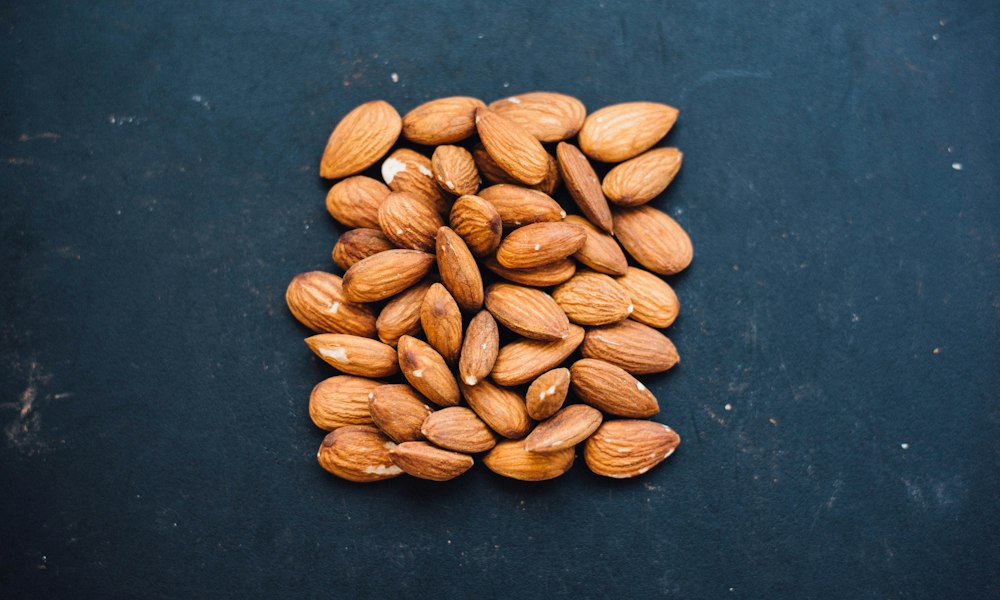
Nuts, seeds and nut butters are the leaders in calorie content: a handful of nuts can give about 200 kcal. Dried fruit is concentrated carbohydrates. Granola, especially with nuts, combines both components. Such foods are worth keeping on hand — in a bag, in a desk drawer.
Liquid calories are even easier to “fit in.” A shake of milk, banana, rolled oats, peanut butter and protein easily gives 600–800 kcal and 40+ g of protein, and it is much easier to drink than to eat the equivalent in solid food.
It is important not to overdo the fiber: large amounts of vegetables and whole grains in snacks increase satiety and can “eat up” the appetite for the main meal. Vegetables are better left for lunch and dinner.
Examples of snacks
Below are snack options that the editorial team considers practical. The figures are approximate: the content of calories and protein depends on the portion and the specific products.
| Snack | Kcal (approx.) | Protein, g (approx.) | When convenient |
|---|---|---|---|
| “Homemade” gainer shake: milk, banana, oats, peanut butter, protein | 600–800 | 40–50 | After training, between meals |
| Greek yogurt with granola and honey | 350–450 | 20–25 | Morning snack |
| Wholegrain sandwich with chicken or tuna | 400–500 | 30–35 | Work day |
| Quark with nuts and berries | 350–450 | 25–30 | Before sleep |
| A handful of nuts and dried fruit | 300–400 | 8–12 | On the go |
| Rice cakes with peanut butter and banana | 350–450 | 10–12 | Pre-workout |
Note that nuts and dried fruit provide little protein. They should be combined with a dairy product, eggs or protein so that the snack works both for calories and for protein.
Store-bought gainers are a convenient but not mandatory option. Many of them contain large amounts of simple sugars; a homemade shake allows you to control the composition and often costs less.
For those who work in an office, an effective strategy is to prepare snacks the evening before: a container of quark, a sandwich, a packet of nuts. The absence of prepared food is the most common reason for missed snacks.
How not to gain excess fat
Easy access to high-calorie snacks has a downside: the surplus easily becomes excessive. Excess calories beyond the needs of muscle growth go mostly into fat tissue, which then has to be removed during cutting.
Iraki and colleagues (2019) advise aiming at slow gain — roughly 0.25–0.5% of body weight per week, with experienced athletes closer to the lower limit. Monitoring the weekly average weight and waist measurement helps to adjust the number of snacks in time.
Confectionery, chips and sweet drinks formally also help to gain calories, but they provide little protein and few micronutrients. A small amount of them in the diet is not critical, but the basis of snacks should be foods with protein and healthy fats.
If weight is growing faster than planned but strength is not, the first thing worth cutting is excess liquid calories and high-calorie “on-the-go snacks.” If the weight is stalling — on the contrary, add one snack or increase the portion of the shake.
Editorial conclusions
Snacks are a simple and effective tool for reaching a calorie surplus and distributing protein evenly during mass gaining. Optimally 2–3 snacks of 300–500 kcal and 15–30 g of protein.
Energy-dense foods — nuts, nut butters, granola, dried fruit, homemade shakes — help those who find it hard to eat a lot. Protein before sleep is a snack with evidence-based support.
Control the rate of weight gain so that the surplus works for muscle, not for fat.
We also recommend our materials on the athlete’s breakfast, gainers and protein before sleep.
References
- Slater GJ, Dieter BP, Marsh DJ, et al. Is an energy surplus required to maximize skeletal muscle hypertrophy associated with resistance training. Front Nutr. 2019;6:131.
- Iraki J, Fitschen P, Espinar S, Helms E. Nutrition recommendations for bodybuilders in the off-season: a narrative review. Sports (Basel). 2019;7(7):154.
- Areta JL, Burke LM, Ross ML, et al. Timing and distribution of protein ingestion during prolonged recovery from resistance exercise alters myofibrillar protein synthesis. J Physiol. 2013;591(9):2319–2331.
- Res PT, Groen B, Pennings B, et al. Protein ingestion before sleep improves postexercise overnight recovery. Med Sci Sports Exerc. 2012;44(8):1560–1569.
- Snijders T, Res PT, Smeets JS, et al. Protein ingestion before sleep increases muscle mass and strength gains during prolonged resistance-type exercise training in healthy young men. J Nutr. 2015;145(6):1178–1184.
- Jäger R, Kerksick CM, Campbell BI, et al. International Society of Sports Nutrition Position Stand: protein and exercise. J Int Soc Sports Nutr. 2017;14:20.
Andriy Melnyk
A strength-sports coach and author of programs for beginner and intermediate levels. Writes about training planning.